When perpendicular becomes concurrent
The Asian Pacific Mathematical Olympiad (APMO) is a long-running regional olympiad that challenges young mathletes across the region with a handful of hard, original problems each year.[^1] Problem 4 from this year's edition is a nice showcase of a common trick: restating an unfriendly definition into a more symmetric one turns the perpendicularity we want into a friendlier concurrence, and the solution follows naturally.
[^1]: For more information and the rest of this year's problems, go to apmo-official.org.
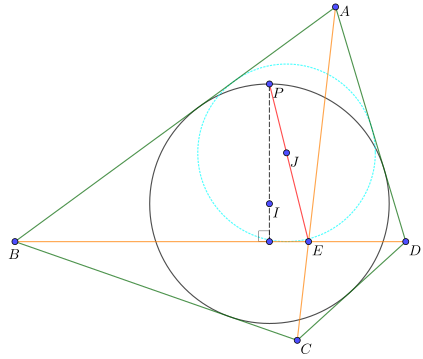
Problem 4. Let be a quadrilateral with an incircle of center . The diagonals and intersect at . Let be the incenter of triangle . The extension of the ray intersects at . Prove that .
 {: w = "100"}
Solution. First, let's modify the statement. It seems more intuitive to let be the endpoint of the diameter of perpendicular to that lies in the interior of . Thus, the problem reduces to showing that the points , and are collinear.
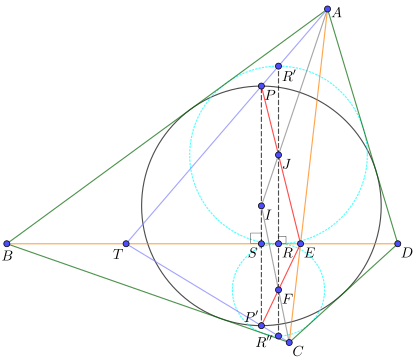
Another key point. The triangle appears to be an arbitrary choice. In other words, the statement should remain valid for too. In this spirit, define and to be the incenter of and the intersection of with that lies within (i.e., the point diametrically opposite to in ), respectively. Then, it should also be true that , and are collinear. With these preparations, we're ready to tackle the problem at hand. Consider the following
Claim 1. The line is perpendicular to .
Proof. Let and be the points where the incircles of and touch . It's known that
where stands for the semiperimeter of . Pitot's theorem implies straightforwardly that . Hence, , so and thus , and are collinear with .
 {: w = "100"}
With this result, we have already used the fact that has an incircle and the definition of . We need to exploit the redefinition of . Let's now argue that
Claim 2. The lines , and concur.
Proof. Let be the point diametrically opposite to in the incircle of . As is the exsimilicenter of this circle and , it turns out that lies on . More importantly, it's known that the point is the contact point of the -excircle of with and that . Thus, this point lies on and satisfies that . Analogously, we can prove that meets at a point where , which forces , implying the desired concurrence.
We're ready to conclude. By Claim 1, observe that . Together with Claim 2, we find that:
with and the antipode of in the incircle of . This result and Thales' theorem jointly imply that and meet each other at a point on , say . Let be the midpoint of the segment . Of course, Thales' theorem ensures that passes through . Now, it is also known that the pole of with respect to is and that forms a harmonic bundle. Let . Then:
which together with implies that is the midpoint of segment , i.e., . Hence and the required collinearity follows.